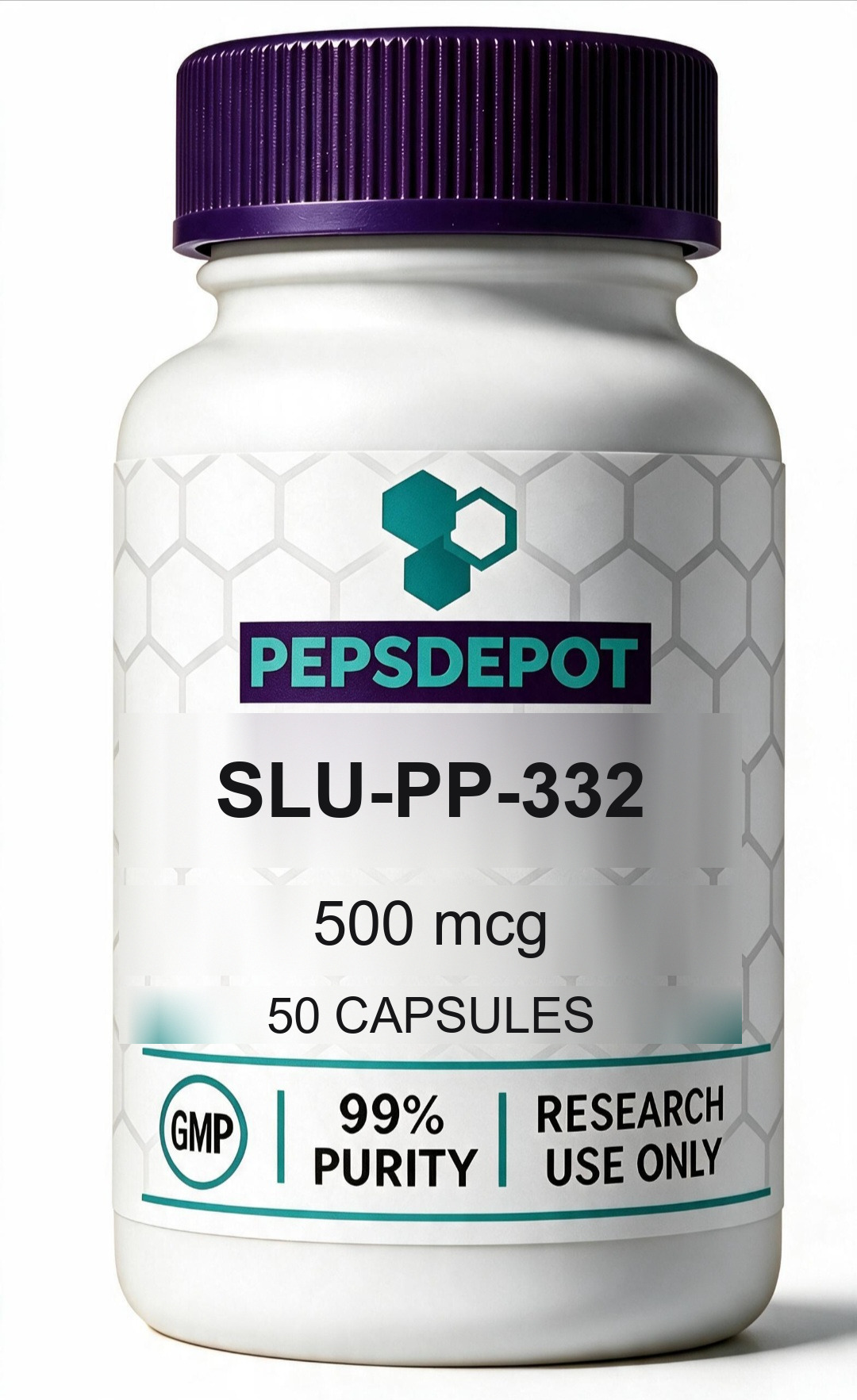
SLU-PP-332 500mcg
SLU-PP-332 is a synthetic pan-ERR (estrogen-related receptor) agonist studied for its effect on oxidative metabolism and exercise-associated gene expression. Supplied as pre-dosed capsules.
- ✅ Order today › 📦 Dispatch (2 business days) › 🚚 Delivery (3–9 business days)
- 🧪 Most lab-tested source in the industry
- ⭐ 500+ reviews across independent platforms
- 🔒 Secure checkout — Crypto, Cash App & Venmo
- 📦 Discreet packaging, guaranteed delivery
Product Details
| Form | Oral capsules — pre-dosed, no reconstitution |
| Purity | ≥99% (verified) |
| Storage | Cool and dry, sealed; protect from light |
| Batch | COA available on request |
Why Choose SLU-PP-332 500mcg?
SLU-PP-332 is a synthetic pan-ERR (estrogen-related receptor) agonist studied for its effect on oxidative metabolism and exercise-associated gene expression. Supplied as pre-dosed capsules.
Key Benefits
- Pan-ERR agonist — oxidative metabolism research
- Pre-dosed capsules — no reconstitution
- Third-party tested — COA available on request
- Ships from the USA in discreet packaging
About SLU-PP-332 500mcg
SLU-PP-332 is a synthetic pan-agonist of the estrogen-related receptors — ERRα, ERRβ and ERRγ. Despite the name, these are orphan nuclear receptors that do not bind estrogen; the label reflects sequence similarity to the estrogen receptor, not shared ligands or function.
ERRs regulate transcription of genes governing mitochondrial biogenesis and oxidative metabolism. That places SLU-PP-332 in a distinct category from metabolic compounds acting on receptors at the cell surface: it works at the level of gene expression rather than acute signalling.
Supplied as pre-dosed capsules for laboratory research use only. Not for human consumption.
Research background
Pan-ERR agonism
SLU-PP-332 activates all three ERR isoforms rather than selecting between them. Since the isoforms differ in tissue distribution — ERRα broadly expressed, ERRγ concentrated in oxidative tissue — pan-agonism produces a different profile from an isoform-selective compound.
Exercise-associated gene expression
The finding that drew attention is that ERR activation induces a transcriptional programme overlapping with the adaptation seen after endurance exercise. This is the origin of the 'exercise mimetic' framing in coverage of the compound.
Mitochondrial biogenesis
Studies have examined markers of mitochondrial content and oxidative capacity in skeletal muscle, which is the mechanism proposed for the endurance findings in rodent models.
Metabolic endpoints in animal models
Rodent work has examined fat mass and exercise capacity, with the transcriptional changes above as the proposed mechanism rather than an acute metabolic effect.
SLU-PP-332 is early-stage. The literature is rodent and cell-culture based, there are no human trials, and it is not an approved drug. The 'exercise in a pill' framing in popular coverage substantially overstates what has been demonstrated.
Storage and stability
| State | Temperature | Practical shelf life |
|---|---|---|
| Sealed bottle, room temperature | 15–25 °C | To printed expiry |
| Sealed bottle, refrigerated | 2–8 °C | To printed expiry |
| Opened bottle, tightly closed | 15–25 °C | Months, if kept dry |
| Exposed to humidity | any | Degrades — discard |
Oral dosage forms are considerably more forgiving than lyophilized peptides. Capsules and tablets are stable at room temperature and require no cold chain, in transit or in storage.
Moisture is the real enemy rather than temperature. Keep the bottle tightly closed, leave the desiccant sachet in place, and avoid storing in a bathroom or anywhere humidity swings. Protect from direct light.
Purity and verification
Every lot is tested by an independent laboratory before release. HPLC establishes purity as a percentage of total content, separating the target compound from synthesis by-products; mass spectrometry confirms molecular identity.
For an encapsulated product there is a second question a vial does not raise: content uniformity. A capsule can be the right compound at the right purity and still be filled inconsistently, so SLU-PP-332 is checked for fill weight consistency across the batch as well as for identity and purity.
The certificate of analysis references the lot number printed on your bottle label. Request it at [email protected].
Published research
Peer-reviewed studies indexed in PubMed. Each links to the abstract and, where a free copy exists, to the full text. We link primary sources rather than summarising them second-hand.
A Synthetic ERR Agonist Alleviates Metabolic Syndrome
Novel Pan-ERR Agonists Ameliorate Heart Failure Through Enhancing Cardiac Fatty Acid Metabolism and Mitochondrial Function
Frequently asked questions
What are estrogen-related receptors?
Is SLU-PP-332 an 'exercise mimetic'?
Is SLU-PP-332 a peptide?
Does this need refrigerated shipping?
Is a certificate of analysis available?
Do capsules need any preparation?
Customer reviews
Related products