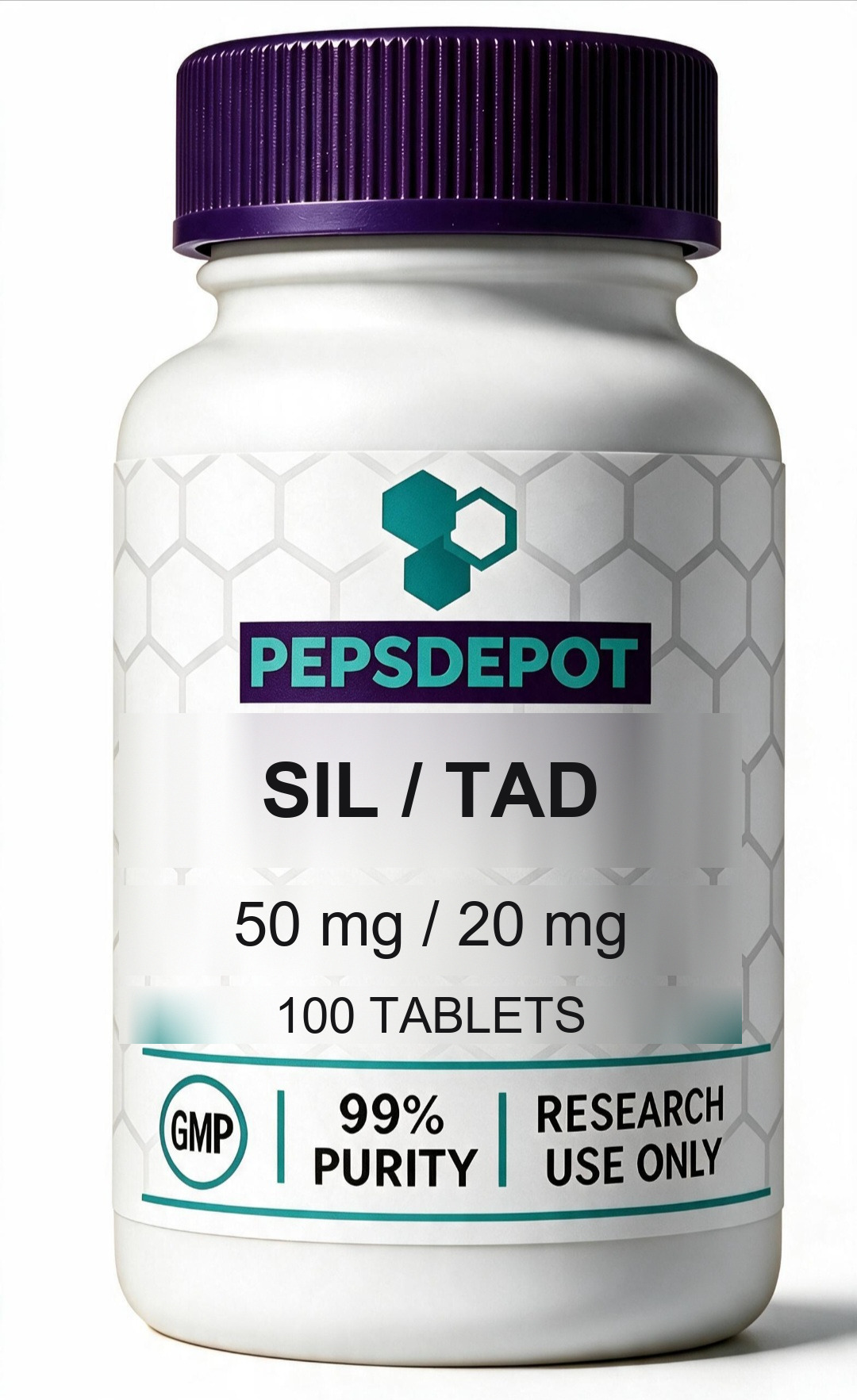
SIL 50mg + TAD 20mg Blend
A combined tablet supplying sildenafil at 50mg and tadalafil at 20mg — two PDE5 inhibitors with markedly different half-lives. Supplied as pre-dosed tablets.
- ✅ Order today › 📦 Dispatch (2 business days) › 🚚 Delivery (3–9 business days)
- 🧪 Most lab-tested source in the industry
- ⭐ 500+ reviews across independent platforms
- 🔒 Secure checkout — Crypto, Cash App & Venmo
- 📦 Discreet packaging, guaranteed delivery
Product Details
| Form | Oral capsules — pre-dosed, no reconstitution |
| Purity | ≥99% (verified) |
| Storage | Cool and dry, sealed; protect from light |
| Batch | COA available on request |
Why Choose SIL 50mg + TAD 20mg Blend?
A combined tablet supplying sildenafil at 50mg and tadalafil at 20mg — two PDE5 inhibitors with markedly different half-lives. Supplied as pre-dosed tablets.
Key Benefits
- Sildenafil 50mg + tadalafil 20mg per tablet
- Two PDE5 inhibitors, different durations
- Verified for identity and content
- Ships from the USA in discreet packaging
About SIL 50mg + TAD 20mg Blend
This tablet supplies two phosphodiesterase type 5 inhibitors in one dosage form: sildenafil at 50mg and tadalafil at 20mg. Both act on the same enzyme, blocking the breakdown of cyclic guanosine monophosphate and prolonging the smooth muscle relaxation that cGMP mediates.
The reason to combine them is pharmacokinetic rather than pharmacodynamic. Sildenafil has a half-life near 4 hours; tadalafil's is roughly 17.5 hours. The combination pairs a fast-onset agent with a long-acting one in a single tablet.
Both are prescription medicines in most jurisdictions. Supplied for laboratory research use only.
Research background
PDE5 inhibition
PDE5 degrades cGMP in vascular smooth muscle. Inhibiting it allows cGMP to accumulate where nitric oxide signalling is already active, producing vasodilation in tissues where PDE5 is concentrated.
Contrasting half-lives
The two agents differ substantially in duration — roughly 4 hours against 17.5. That difference is structural and is the principal distinction between them in the clinical literature.
Isoform selectivity
Sildenafil and tadalafil differ in their selectivity across PDE isoforms, which accounts for the different side-effect patterns reported in comparative studies rather than any difference in primary mechanism.
Other indications
Both compounds have literature beyond their best-known use — sildenafil in pulmonary arterial hypertension, tadalafil in pulmonary hypertension and benign prostatic hyperplasia — reflecting PDE5 distribution across tissues.
Both are approved prescription medicines with extensive clinical literature. They carry significant contraindications, most importantly with nitrate medications, where the combination can cause severe hypotension. Use under a qualified prescriber.
Storage and stability
| State | Temperature | Practical shelf life |
|---|---|---|
| Sealed bottle, room temperature | 15–25 °C | To printed expiry |
| Sealed bottle, refrigerated | 2–8 °C | To printed expiry |
| Opened bottle, tightly closed | 15–25 °C | Months, if kept dry |
| Exposed to humidity | any | Degrades — discard |
Oral dosage forms are considerably more forgiving than lyophilized peptides. Capsules and tablets are stable at room temperature and require no cold chain, in transit or in storage.
Moisture is the real enemy rather than temperature. Keep the bottle tightly closed, leave the desiccant sachet in place, and avoid storing in a bathroom or anywhere humidity swings. Protect from direct light.
Purity and verification
Every lot is tested by an independent laboratory before release. HPLC establishes purity as a percentage of total content, separating the target compound from synthesis by-products; mass spectrometry confirms molecular identity.
For an encapsulated product there is a second question a vial does not raise: content uniformity. A capsule can be the right compound at the right purity and still be filled inconsistently, so This blend is checked for fill weight consistency across the batch as well as for identity and purity.
The certificate of analysis references the lot number printed on your bottle label. Request it at [email protected].
Frequently asked questions
Why combine two PDE5 inhibitors?
Are the mechanisms different?
Are these prescription medicines?
Does this need refrigerated shipping?
Is a certificate of analysis available?
Do capsules need any preparation?
Customer reviews
Related products