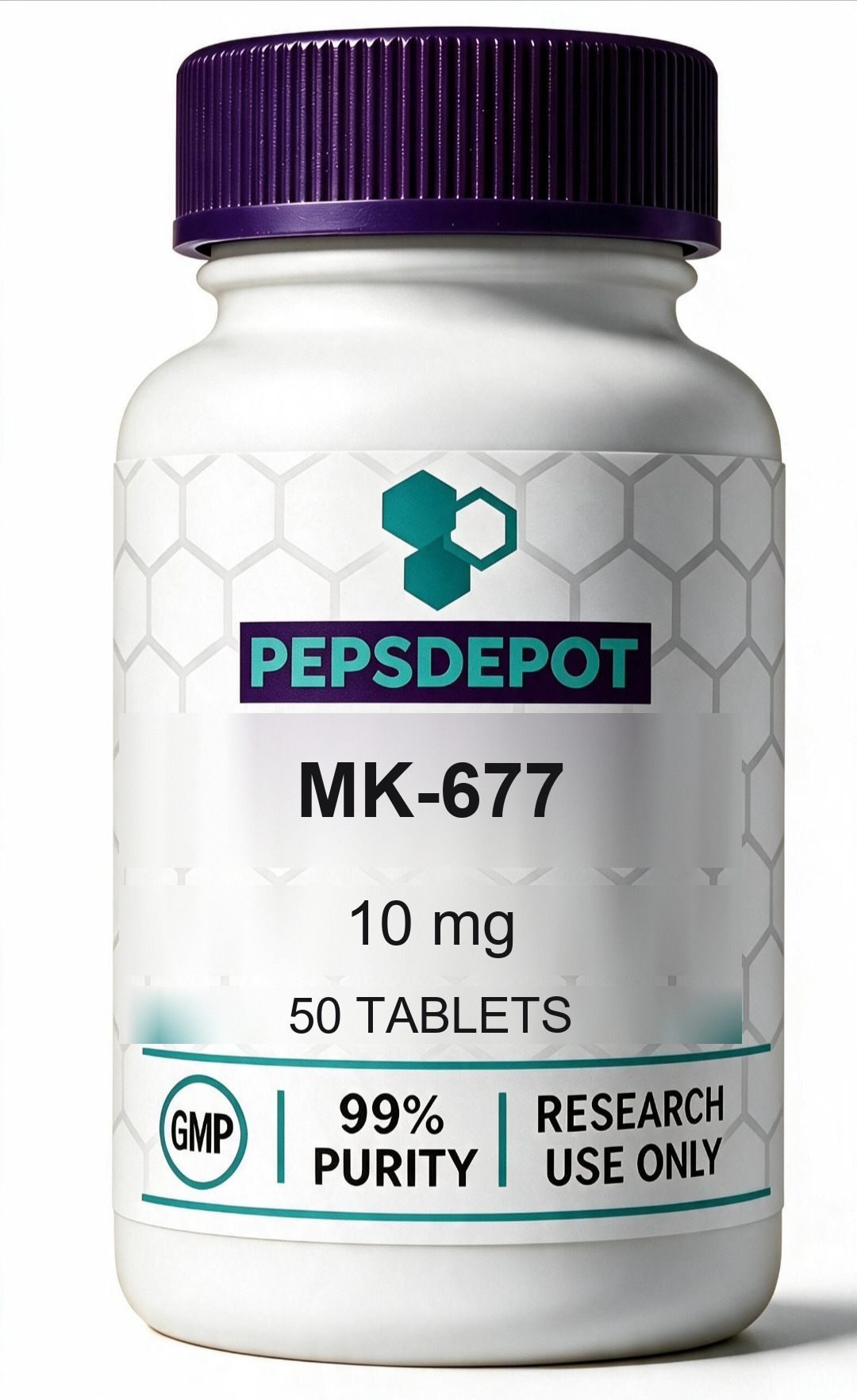
MK-677 10mg
MK-677 (ibutamoren) is a non-peptide ghrelin receptor agonist studied for its effect on endogenous growth hormone and IGF-1 signalling. Unlike GHRH analogues it acts at the ghrelin/GHS receptor and is orally active. Supplied as pre-dosed tablets.
- ✅ Order today › 📦 Dispatch (2 business days) › 🚚 Delivery (3–9 business days)
- 🧪 Most lab-tested source in the industry
- ⭐ 500+ reviews across independent platforms
- 🔒 Secure checkout — Crypto, Cash App & Venmo
- 📦 Discreet packaging, guaranteed delivery
Product Details
| Form | Oral capsules — pre-dosed, no reconstitution |
| Purity | ≥99% (verified) |
| Storage | Cool and dry, sealed; protect from light |
| Batch | COA available on request |
Why Choose MK-677 10mg?
MK-677 (ibutamoren) is a non-peptide ghrelin receptor agonist studied for its effect on endogenous growth hormone and IGF-1 signalling. Unlike GHRH analogues it acts at the ghrelin/GHS receptor and is orally active. Supplied as pre-dosed tablets.
Key Benefits
- Ghrelin / GHS receptor agonist — orally active
- Pre-dosed tablets — no reconstitution
- Third-party tested — COA available on request
- Ships from the USA in discreet packaging
About MK-677 10mg
MK-677 (ibutamoren) is a non-peptide agonist at the growth hormone secretagogue receptor — the same receptor targeted by the hormone ghrelin. It is orally active and long-acting, which is what separates it from the injectable secretagogues.
It is worth being precise about what it is not: MK-677 is not growth hormone, and it is not a GHRH analogue. It acts at the ghrelin receptor, a different receptor from the one tesamorelin or sermorelin target, and it stimulates the pituitary to release its own growth hormone rather than supplying any.
Supplied as pre-dosed tablets for laboratory research use only. Not for human consumption.
Research background
Ghrelin receptor agonism
MK-677 binds the growth hormone secretagogue receptor (GHS-R1a), which ghrelin occupies endogenously. Receptor activation stimulates pituitary growth hormone release while leaving the feedback loop that regulates it intact.
Pulsatile release and IGF-1
Because release remains pulsatile and under normal feedback control, studies typically track IGF-1 as the downstream marker rather than growth hormone itself, which has a short half-life and fluctuates too quickly to assay conveniently.
Oral bioavailability
A significant part of the literature concerns pharmacokinetics: MK-677 is a non-peptide, so unlike GHRH analogues it survives oral administration. That property is central to why it was developed.
Body composition and appetite
Ghrelin signalling is associated with appetite, and studies have examined food intake alongside lean mass endpoints — the two being difficult to separate given the shared receptor.
MK-677 has been studied in human trials but was never approved for any indication. It is supplied here as a research reference compound. It is a prohibited substance in competitive sport under WADA rules.
Storage and stability
| State | Temperature | Practical shelf life |
|---|---|---|
| Sealed bottle, room temperature | 15–25 °C | To printed expiry |
| Sealed bottle, refrigerated | 2–8 °C | To printed expiry |
| Opened bottle, tightly closed | 15–25 °C | Months, if kept dry |
| Exposed to humidity | any | Degrades — discard |
Oral dosage forms are considerably more forgiving than lyophilized peptides. Capsules and tablets are stable at room temperature and require no cold chain, in transit or in storage.
Moisture is the real enemy rather than temperature. Keep the bottle tightly closed, leave the desiccant sachet in place, and avoid storing in a bathroom or anywhere humidity swings. Protect from direct light.
Purity and verification
Every lot is tested by an independent laboratory before release. HPLC establishes purity as a percentage of total content, separating the target compound from synthesis by-products; mass spectrometry confirms molecular identity.
For an encapsulated product there is a second question a vial does not raise: content uniformity. A capsule can be the right compound at the right purity and still be filled inconsistently, so MK-677 is checked for fill weight consistency across the batch as well as for identity and purity.
The certificate of analysis references the lot number printed on your bottle label. Request it at [email protected].
Published research
Peer-reviewed studies indexed in PubMed. Each links to the abstract and, where a free copy exists, to the full text. We link primary sources rather than summarising them second-hand.
The Safety and Efficacy of Growth Hormone Secretagogues
Beyond the androgen receptor: the role of growth hormone secretagogues in the modern management of body composition in hypogonadal males
Oral ghrelin receptor agonist MK-0677 increases serum insulin-like growth factor 1 in hemodialysis patients: a randomized blinded study
Frequently asked questions
Is MK-677 a SARM?
How does MK-677 differ from tesamorelin or sermorelin?
Why is it supplied as tablets rather than a vial?
Does this need refrigerated shipping?
Is a certificate of analysis available?
Do capsules need any preparation?
Customer reviews
Related products