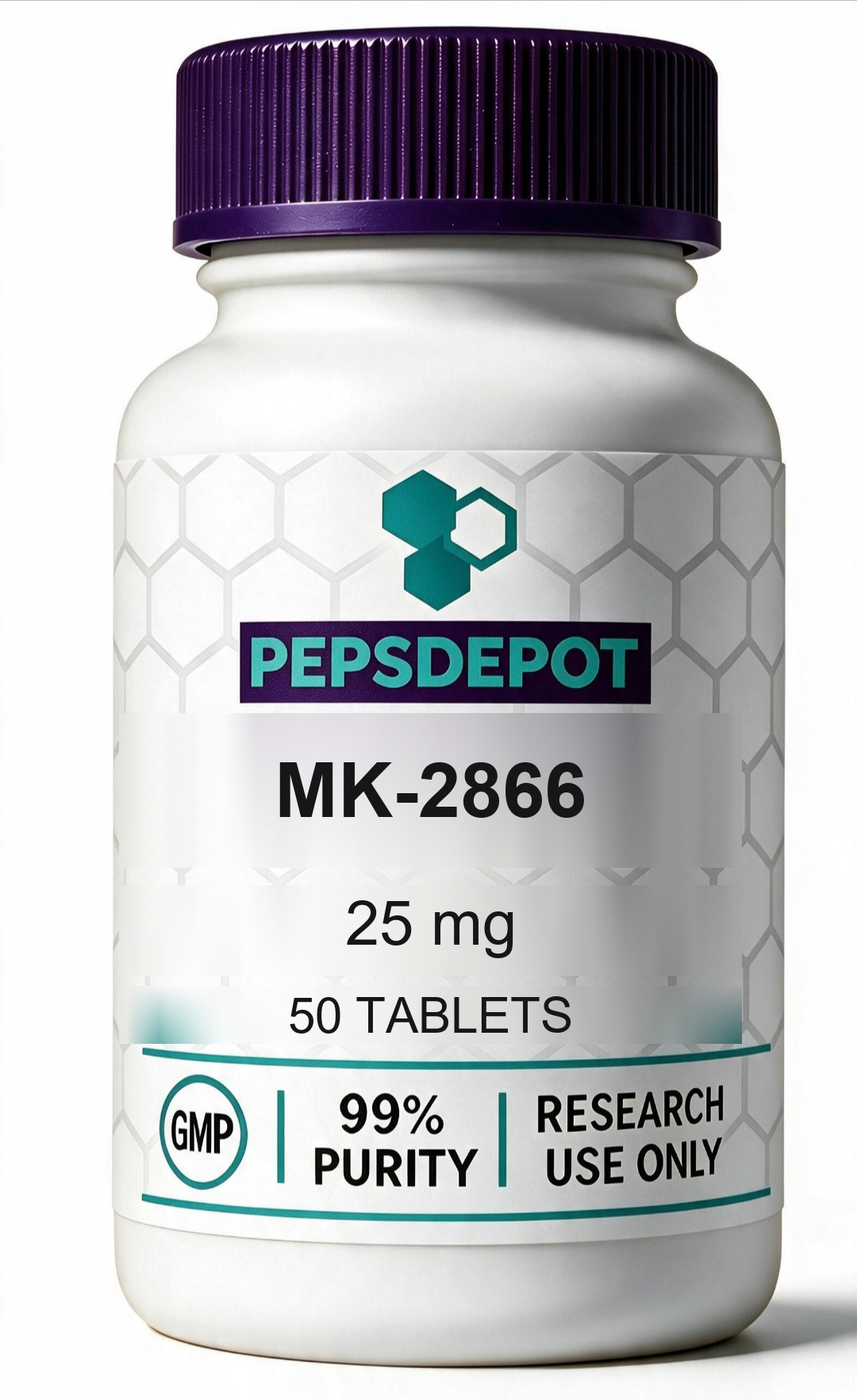
MK-2866 25mg
MK-2866 (ostarine) is a selective androgen receptor modulator studied for tissue-selective activity at the androgen receptor, with the research interest being selectivity between muscle and other androgen-responsive tissue. Supplied as pre-dosed tablets.
- ✅ Order today › 📦 Dispatch (2 business days) › 🚚 Delivery (3–9 business days)
- 🧪 Most lab-tested source in the industry
- ⭐ 500+ reviews across independent platforms
- 🔒 Secure checkout — Crypto, Cash App & Venmo
- 📦 Discreet packaging, guaranteed delivery
Product Details
| Form | Oral capsules — pre-dosed, no reconstitution |
| Purity | ≥99% (verified) |
| Storage | Cool and dry, sealed; protect from light |
| Batch | COA available on request |
Why Choose MK-2866 25mg?
MK-2866 (ostarine) is a selective androgen receptor modulator studied for tissue-selective activity at the androgen receptor, with the research interest being selectivity between muscle and other androgen-responsive tissue. Supplied as pre-dosed tablets.
Key Benefits
- Selective androgen receptor modulator (SARM)
- Pre-dosed tablets — no reconstitution
- Third-party tested — COA available on request
- Ships from the USA in discreet packaging
About MK-2866 25mg
MK-2866 (ostarine, also catalogued as enobosarm) is a selective androgen receptor modulator — a SARM. SARMs bind the androgen receptor but are non-steroidal, and the research premise is tissue selectivity: activity in muscle and bone with less effect in prostate and other androgen-responsive tissue.
That selectivity is the entire reason the class exists. Whether it holds up in practice, and by what margin, is the central question in the published literature rather than a settled result.
Supplied as pre-dosed tablets for laboratory research use only. Not for human consumption.
Research background
Selective androgen receptor modulation
MK-2866 binds the androgen receptor as a partial agonist. The tissue selectivity reported for SARMs is attributed to differences in receptor conformation and co-regulator recruitment between tissues, rather than to different receptors.
Non-steroidal structure
Unlike anabolic steroids, SARMs are not derived from testosterone and are not substrates for aromatase or 5-alpha reductase. That structural difference is the basis for the differing side-effect profile described in the literature.
Clinical trial history
Enobosarm progressed into human trials for muscle-wasting indications, so a clinical literature exists — including trials that did not meet their endpoints. It was never approved.
Hormonal axis effects
A recurring finding is suppression of endogenous testosterone and of the hypothalamic-pituitary-gonadal axis. This features prominently in the published safety discussion and is not a marginal consideration.
MK-2866 has human trial data but was never approved for any indication. The FDA has issued public warnings about SARMs sold as dietary supplements, and SARMs are prohibited in competitive sport under WADA rules. Supplied here strictly as a research reference compound.
Storage and stability
| State | Temperature | Practical shelf life |
|---|---|---|
| Sealed bottle, room temperature | 15–25 °C | To printed expiry |
| Sealed bottle, refrigerated | 2–8 °C | To printed expiry |
| Opened bottle, tightly closed | 15–25 °C | Months, if kept dry |
| Exposed to humidity | any | Degrades — discard |
Oral dosage forms are considerably more forgiving than lyophilized peptides. Capsules and tablets are stable at room temperature and require no cold chain, in transit or in storage.
Moisture is the real enemy rather than temperature. Keep the bottle tightly closed, leave the desiccant sachet in place, and avoid storing in a bathroom or anywhere humidity swings. Protect from direct light.
Purity and verification
Every lot is tested by an independent laboratory before release. HPLC establishes purity as a percentage of total content, separating the target compound from synthesis by-products; mass spectrometry confirms molecular identity.
For an encapsulated product there is a second question a vial does not raise: content uniformity. A capsule can be the right compound at the right purity and still be filled inconsistently, so MK-2866 is checked for fill weight consistency across the batch as well as for identity and purity.
The certificate of analysis references the lot number printed on your bottle label. Request it at [email protected].
Published research
Peer-reviewed studies indexed in PubMed. Each links to the abstract and, where a free copy exists, to the full text. We link primary sources rather than summarising them second-hand.
Cancer Cachexia: Its Mechanism and Clinical Significance
Ostarine-Induced Myogenic Differentiation in C2C12, L6, and Rat Muscles
The selective androgen receptor modulator GTx-024 (enobosarm) improves lean body mass and physical function in healthy elderly men and postmenopausal women: results of a double-blind, placebo-controlled phase II trial
Frequently asked questions
What is a SARM?
Is MK-2866 the same as MK-677?
How do SARMs differ from anabolic steroids?
Does this need refrigerated shipping?
Is a certificate of analysis available?
Do capsules need any preparation?
Customer reviews
Related products