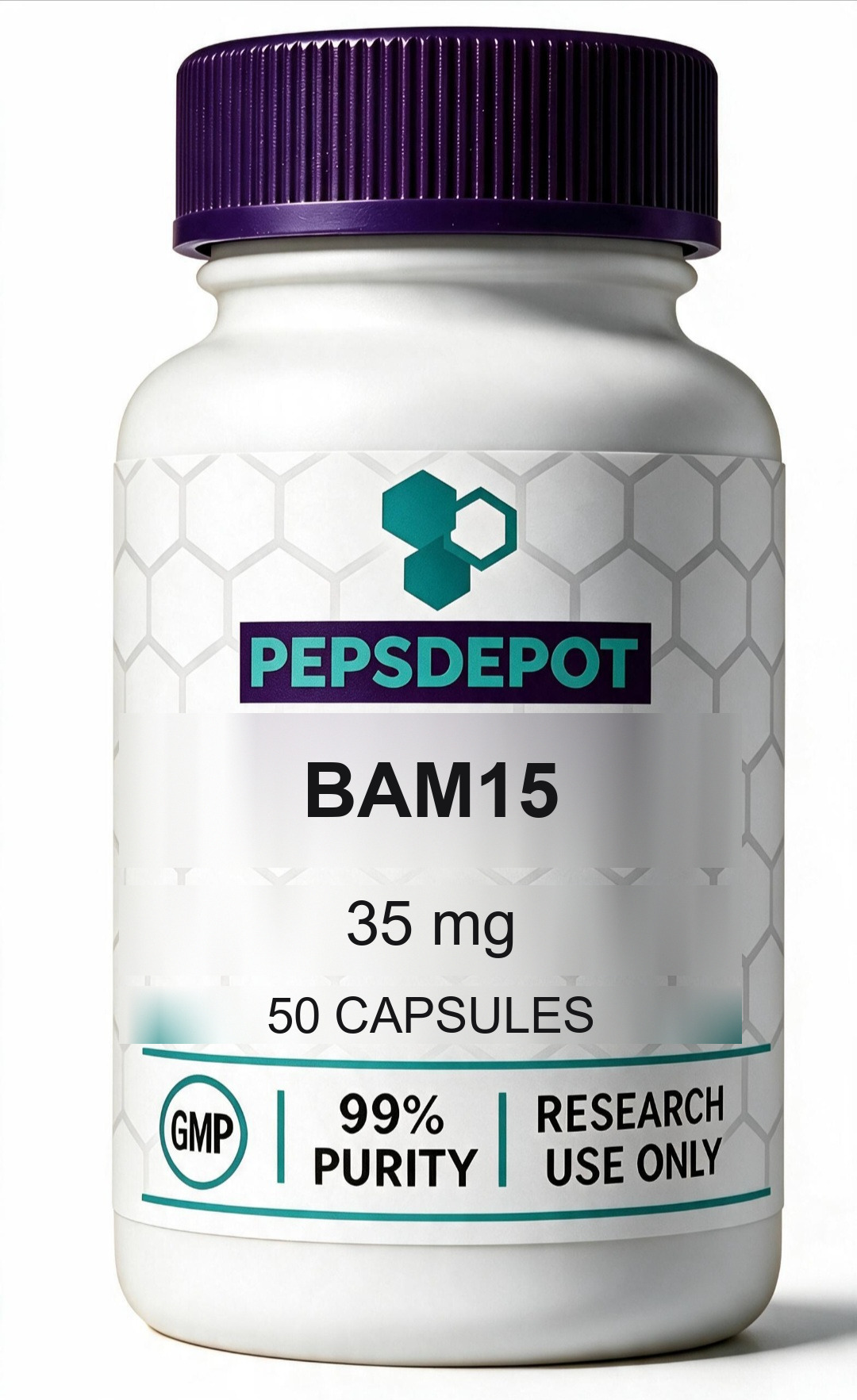
BAM15 35mg
BAM15 is a mitochondrial protonophore uncoupler studied for its effect on cellular respiration and substrate oxidation without the membrane depolarisation associated with older uncouplers. Supplied as pre-dosed capsules.
- ✅ Order today › 📦 Dispatch (2 business days) › 🚚 Delivery (3–9 business days)
- 🧪 Most lab-tested source in the industry
- ⭐ 500+ reviews across independent platforms
- 🔒 Secure checkout — Crypto, Cash App & Venmo
- 📦 Discreet packaging, guaranteed delivery
Product Details
| Form | Oral capsules — pre-dosed, no reconstitution |
| Purity | ≥99% (verified) |
| Storage | Cool and dry, sealed; protect from light |
| Batch | COA available on request |
Why Choose BAM15 35mg?
BAM15 is a mitochondrial protonophore uncoupler studied for its effect on cellular respiration and substrate oxidation without the membrane depolarisation associated with older uncouplers. Supplied as pre-dosed capsules.
Key Benefits
- Mitochondrial uncoupler — metabolic research
- Pre-dosed capsules — no reconstitution
- Third-party tested — COA available on request
- Ships from the USA in discreet packaging
About BAM15 35mg
BAM15 is a mitochondrial protonophore — a small molecule that carries protons across the inner mitochondrial membrane, dissipating the proton gradient that would otherwise drive ATP synthesis. The energy is released as heat instead, which is what the term 'uncoupler' describes.
Chemical uncouplers are not new. What made BAM15 a subject of renewed research is selectivity: earlier compounds in this class, most notoriously 2,4-dinitrophenol, also depolarise the plasma membrane, which is where their well-documented toxicity comes from. BAM15 was characterised as acting on the mitochondrial membrane with substantially less plasma membrane effect.
Supplied as pre-dosed capsules for laboratory research use only. Not for human consumption.
Research background
Mitochondrial selectivity
The defining published claim is that BAM15 depolarises the mitochondrial membrane without the plasma membrane depolarisation seen with older protonophores. That selectivity is the reason it is studied at all rather than being of purely historical interest.
Substrate oxidation and energy expenditure
Uncoupling increases substrate oxidation because the electron transport chain runs without the constraint of ATP demand. Animal studies have examined fat oxidation and energy expenditure using this as the mechanism.
Insulin sensitivity models
A related strand examines glucose handling in diet-induced obesity models, on the hypothesis that reducing lipid accumulation in muscle and liver alters insulin signalling.
Comparison with older uncouplers
Much of the published work is explicitly comparative, measuring BAM15 against DNP and FCCP to characterise the safety margin that motivated its development.
The literature is preclinical — cell culture and rodent models. BAM15 has not completed human clinical trials and is not an approved drug. Mitochondrial uncouplers as a class have a serious historical safety record, which is precisely why selectivity is the central research question.
Storage and stability
| State | Temperature | Practical shelf life |
|---|---|---|
| Sealed bottle, room temperature | 15–25 °C | To printed expiry |
| Sealed bottle, refrigerated | 2–8 °C | To printed expiry |
| Opened bottle, tightly closed | 15–25 °C | Months, if kept dry |
| Exposed to humidity | any | Degrades — discard |
Oral dosage forms are considerably more forgiving than lyophilized peptides. Capsules and tablets are stable at room temperature and require no cold chain, in transit or in storage.
Moisture is the real enemy rather than temperature. Keep the bottle tightly closed, leave the desiccant sachet in place, and avoid storing in a bathroom or anywhere humidity swings. Protect from direct light.
Purity and verification
Every lot is tested by an independent laboratory before release. HPLC establishes purity as a percentage of total content, separating the target compound from synthesis by-products; mass spectrometry confirms molecular identity.
For an encapsulated product there is a second question a vial does not raise: content uniformity. A capsule can be the right compound at the right purity and still be filled inconsistently, so BAM15 is checked for fill weight consistency across the batch as well as for identity and purity.
The certificate of analysis references the lot number printed on your bottle label. Request it at [email protected].
Published research
Peer-reviewed studies indexed in PubMed. Each links to the abstract and, where a free copy exists, to the full text. We link primary sources rather than summarising them second-hand.
BAM15 treats mouse sepsis and kidney injury, linking mortality, mitochondrial DNA, tubule damage, and neutrophils
Mitochondrial uncoupling attenuates sarcopenic obesity by enhancing skeletal muscle mitophagy and quality control
Mitochondrial uncoupler BAM15 reverses diet-induced obesity and insulin resistance in mice
Frequently asked questions
What does 'mitochondrial uncoupler' mean?
How is BAM15 different from DNP?
Is BAM15 a peptide?
Does this need refrigerated shipping?
Is a certificate of analysis available?
Do capsules need any preparation?
Customer reviews
Related products