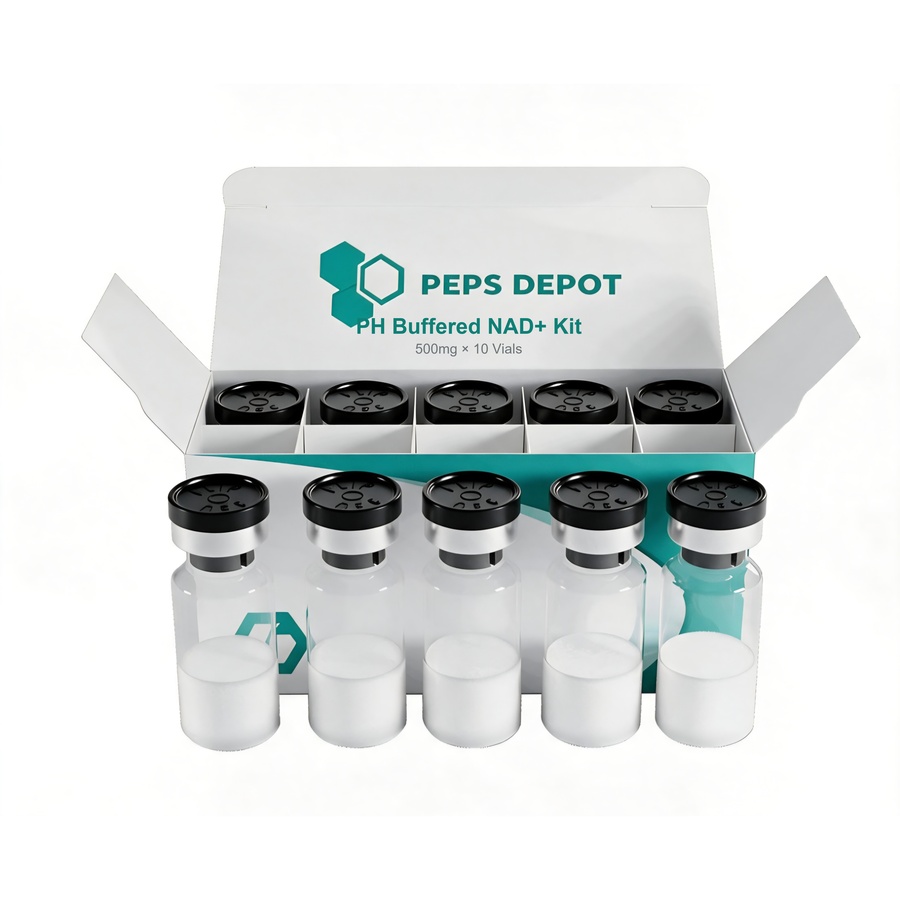
PH Buffered NAD+ 5,000MG Kit
NAD+ (nicotinamide adenine dinucleotide) is a coenzyme central to cellular energy metabolism, DNA repair and sirtuin signalling. Supplied in research-grade format from a verified batch.
- ✅ Order today › 📦 Dispatch (2 business days) › 🚚 Delivery (3–9 business days)
- 🧪 Most lab-tested source in the industry
- ⭐ 500+ reviews across independent platforms
- 🔒 Secure checkout — Crypto, Cash App & Venmo
- 📦 Discreet packaging, guaranteed delivery
Product Details
| Purity | ≥99% (LC-MS verified) |
| Form | Lyophilized powder, preservative free |
| Storage | Cool and dry; refrigerate after reconstitution |
| Batch | COA available on request |
Why Choose PH Buffered NAD+ 5,000MG Kit?
NAD+ (nicotinamide adenine dinucleotide) is a coenzyme central to cellular energy metabolism, DNA repair and sirtuin signalling. Supplied in research-grade format from a verified batch.
Key Benefits
- Cellular energy and longevity research compound
- Third-party tested — COA available on request
- Lyophilized, preservative free
- Ships from the USA in discreet packaging
About PH Buffered NAD+ 5,000MG Kit
Nicotinamide adenine dinucleotide (NAD+) is a coenzyme present in every living cell, where it functions as the primary electron carrier in redox reactions. It is not a peptide — it is a dinucleotide, built from nicotinamide and adenine riboside units joined by phosphate groups.
Its research prominence comes from two roles: as the redox cofactor driving cellular energy metabolism, and as the required substrate for sirtuins and PARP enzymes, which consume it during DNA repair and gene regulation. Cellular NAD+ declines with age, which is the basis of most longevity research interest.
Supplied for laboratory research use only. Not for human consumption.
Research background
Redox cofactor function
NAD+ cycles between oxidised (NAD+) and reduced (NADH) states, carrying electrons through glycolysis, the citric acid cycle and oxidative phosphorylation. The ratio between the two forms is itself a regulated signal.
Sirtuin substrate
Sirtuins are NAD+-dependent deacetylases involved in gene regulation and metabolic adaptation. Because they consume NAD+ rather than merely binding it, their activity is directly limited by NAD+ availability — the central observation behind NAD+ research.
DNA repair and PARP activity
PARP enzymes also consume NAD+ during DNA damage response. Extensive DNA damage depletes the cellular pool, creating competition between repair and sirtuin activity that researchers have examined in detail.
Precursor comparisons
A substantial literature compares direct NAD+ with precursors such as nicotinamide riboside and nicotinamide mononucleotide, examining which route most effectively raises intracellular levels.
NAD+ research spans cell culture, animal models and some human studies. It is sold as a research compound here and is not an approved drug.
Reconstitution
- Equilibrate firstAllow the vial to reach room temperature before opening. Introducing solvent into a cold vial promotes condensation, which affects both concentration accuracy and stability.
- Select the diluentBacteriostatic water — sterile water with 0.9% benzyl alcohol — is standard where the solution will be held for more than a few days. Plain sterile water is appropriate only for single-session use with no storage.
- Add slowly, down the wallDirect the solvent against the inner wall of the vial rather than onto the powder. A stream striking the lyophilized cake causes localized shear that can denature peptide chains.
- Do not shakeSwirl gently, or simply let the vial stand. Agitation introduces air and mechanical stress, and both degrade peptides. Full dissolution usually takes a minute or two.
- Inspect before useA correctly reconstituted solution is clear and colourless. Cloudiness, visible particulate or discolouration indicates a problem with the material or the diluent.
Concentration is set by the volume of diluent added. For a 500mg vial, 5mL of bacteriostatic water yields 100mg/mL. Calculate the working concentration your protocol requires rather than following a generic figure.
Storage and stability
| State | Temperature | Practical shelf life |
|---|---|---|
| Lyophilized, sealed | −20 °C | 24+ months |
| Lyophilized, sealed | 2–8 °C | ~12 months |
| Lyophilized, sealed | Room temperature | Weeks — transit only |
| Reconstituted, bacteriostatic water | 2–8 °C | ~3–4 weeks |
| Reconstituted, sterile water | 2–8 °C | Same session |
Lyophilized peptide is stable enough to survive shipping at ambient temperature, which is why cold-chain courier service is not required for transit. Long-term storage is a different matter — material intended to be held for months belongs in a freezer.
Protect from light, and avoid repeated freeze-thaw cycles. Each cycle causes measurable degradation, so dividing a reconstituted stock into single-use aliquots before freezing is preferable to thawing and refreezing one vial repeatedly.
Purity and verification
Every lot is tested by an independent laboratory using two orthogonal methods. HPLC (high-performance liquid chromatography) establishes purity as a percentage of total peptide content, separating the target compound from truncated sequences and synthesis by-products. LC-MS (liquid chromatography–mass spectrometry) confirms molecular identity by mass.
Both matter. Purity alone is insufficient — a 99% pure sample of the wrong compound is still the wrong compound. Together the two tests establish identity and quality, which is why NAD+ is released only after both pass.
The certificate of analysis references the lot number printed on your vial label. Request the COA for your lot at [email protected].
Published research
Peer-reviewed studies indexed in PubMed. Each links to the abstract and, where a free copy exists, to the full text. We link primary sources rather than summarising them second-hand.
The Safety and Antiaging Effects of Nicotinamide Mononucleotide in Human Clinical Trials: an Update
Nicotinamide mononucleotide increases muscle insulin sensitivity in prediabetic women
Nicotinamide mononucleotide (NMN) as an anti-aging health product - Promises and safety concerns
Frequently asked questions
Is NAD+ a peptide?
How do you reconstitute NAD+?
What is the difference between NAD+ and pH-buffered NAD+?
How does NAD+ differ from NMN or nicotinamide riboside?
Does this need refrigerated shipping?
Is a certificate of analysis available?
Is NAD+ approved for human use?
Customer reviews
Related compounds
Compounds studied alongside this one, or acting through related pathways.
Related products